
Faulkner County Court Records After Arrest
After a Faulkner County jail arrest, two public-record systems may exist at the same time. The jail side begins at booking, usually at Unit Two, where the sheriff's office creates the booking computer record and may list arrest charges, booking date, arresting agency, bond, mugshot, and a profile link. The court side begins when the Prosecuting Attorney for the 20th Judicial District reviews the law-enforcement case and files, amends, or declines criminal charges in court. Those court records are maintained through the court and clerk system, not by the jail roster.
That difference matters for anyone checking a case after an arrest. The Faulkner County jail inmate records page is the custody and booking path. The Faulkner County jail mugshots page covers booking photos. Court records after a jail arrest are used for formal charges, hearings, filings, warrants, bond actions, dispositions, and later sealing questions. A booking charge is an allegation at intake. A court charge is the charge that appears in the case after prosecutor or court action.
Search Faulkner County Court Records
Faulkner County court records are searched through Arkansas court systems and the Circuit Clerk's office. The official county Circuit Clerk page says the clerk maintains circuit-court proceedings, dockets, summonses, warrants, orders, judgments, injunctions, pending files, past cases, and dispositions. It also states that court records back to January 1, 2009 are available through Public CourtConnect or Search ARCourts. Arkansas AOC announced Search ARCourts as the modern public search portal replacing Public CourtConnect.
- Start with the FCSO roster and write down the full name, booking number, arresting agency, booking date, and booking charges.
- Call 501-450-4914 if the jail profile warns that charges, bail, or case numbers may have changed.
- Open Search ARCourts or the newer Search ARCourts portal.
- Search by participant or defendant name. Narrow by Faulkner County and date if the live portal permits.
- Search by case number if jail staff, a citation, a warrant, the clerk, or another court document provides one.
- Review the case for formal charge language, status, events, hearings, filings, disposition, and future court dates.
- For older or unavailable files, contact the Faulkner County Circuit Clerk at 501-450-4911.
The court search portal inspected for this project appears in the Search ARCourts capture below.
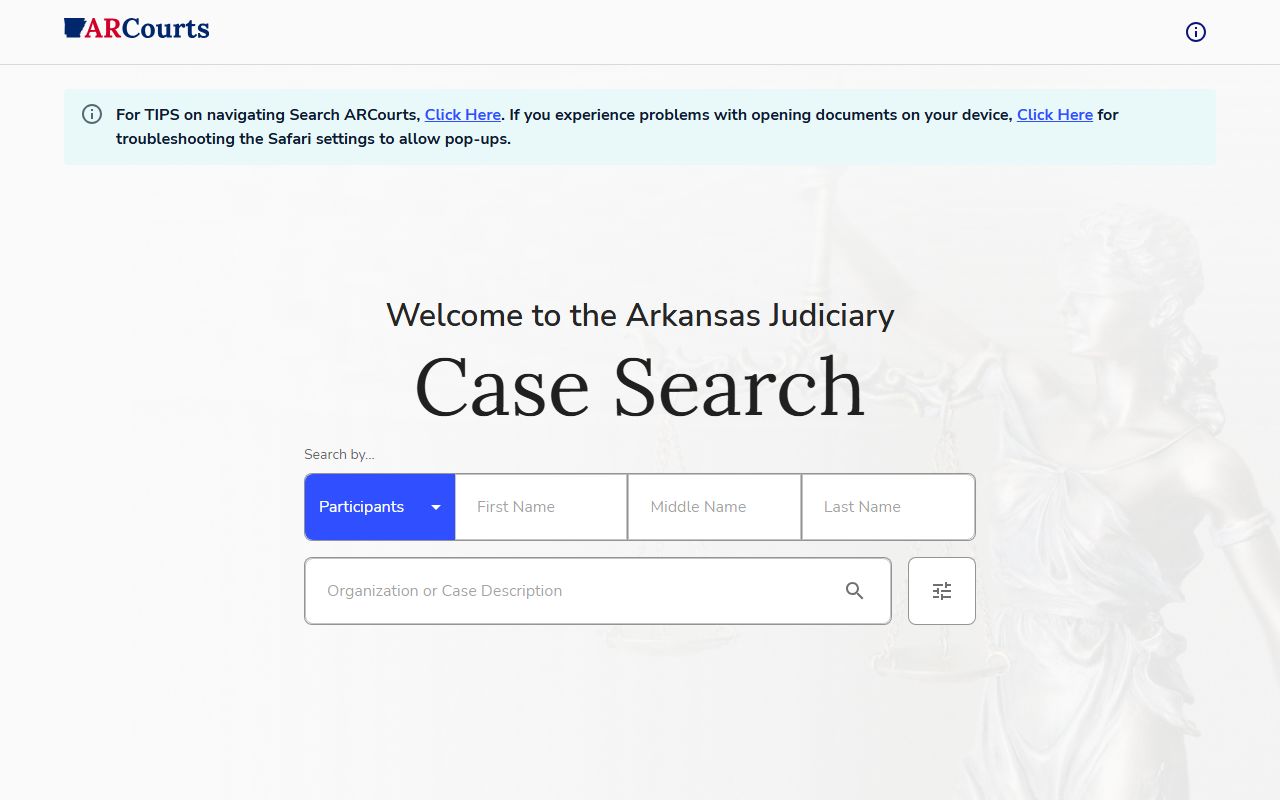
The portal is the public case-search path, while the Circuit Clerk remains the local custodian for court files that need clerk help.
Faulkner County Court Search Fields
Search ARCourts is dynamic, so the research could not extract every live field label from static page text. The usable search paths were still clear enough for a Faulkner County court records after arrest workflow. Participant search is the practical route when only a name is known. Case-number search is stronger when the roster, a warrant, a citation, the clerk, or detention staff provides the number.
| Field Label | Type | Required | Options / Format Notes |
|---|---|---|---|
| Search by Participants | tab or mode | optional | Used for person or party searches. |
| Search by Cases | tab or mode | optional | Used when a case number is known. |
| Participant name | text | unspecified | Use the defendant name from the booking record when possible. |
| Case number | text | unspecified | Use the number from jail staff, a warrant, citation, or clerk file. |
| Court or county filters | filter/dropdown | unspecified | Search ARCourts covers Arkansas court information; live filters may vary. |
| Search/submit | button | unspecified | Runs the selected court-record search. |
Charges Filed After Arrest
The arrest-to-court path in Faulkner County can be summarized as arrest, booking, first appearance or bond action, prosecutor review, court filing, court events, and final disposition. The 20th Judicial District Prosecuting Attorney handles state criminal prosecutions for Faulkner, Van Buren, and Searcy counties. The prosecutor's office works with local law-enforcement agencies and decides what formal state charges are filed after a jail arrest. Those formal filings may not match the booking charges word for word.
| Document | Who Files or Starts It | Common Use | What It Means |
|---|---|---|---|
| Complaint | Officer or prosecutor | Often early criminal filing or misdemeanor path | Sets out the accusation that starts or supports a case. |
| Information | Prosecutor | Many felony prosecutions | Formal prosecutor-filed charge document in court. |
| Indictment | Grand jury | Serious or grand-jury-presented cases | Formal charge returned by a grand jury. |
The prosecutor for the district is Carol Crews, and the official county page lists the Faulkner office at 510 S German Lane in Conway. The office phone is 501-450-4927, and the office hours are 8:00 a.m. to 4:30 p.m. Monday through Friday, excluding holidays. The prosecutor's role is prosecution, not jail custody management or roster correction.
Faulkner County Charge Status
Charge status can change after a Faulkner County arrest. A person may be booked on one or more arrest charges, then later face amended, reduced, added, dismissed, or nolle prossed court charges. The roster warning about changing charges and bond reflects this process. A court record should be read by date, filing, count, and status rather than by the first charge label seen on the jail roster.
| Status | What It Means |
|---|---|
| Pending | The court charge remains open and has not reached final disposition. |
| Amended | The charge language, count, level, or filing may have been changed by court action. |
| Reduced | The charge was lowered from a more serious allegation to a less serious one. |
| Dismissed | The charge was ended by court order or prosecutor action and is not a conviction. |
| Nolle prosequi | The prosecutor declines to proceed on that charge, often shown as nolle prossed. |
| Disposed | The case or count has a final outcome, such as plea, trial result, dismissal, or other order. |
Note: A booking charge can explain why someone entered jail, but the court case shows what was formally filed.
Bond After Jail Arrest
Bond information often links the jail record and the court record. FCSO states that bond and bail are often used interchangeably, although technical differences exist. The purpose is to ensure that the arrested person appears in court. The sheriff page says judges generally determine the amount of bond while the sheriff determines the sufficiency of the bond. It also cites Arkansas criminal procedure rules for first appearances and bond setting when the person remains in custody.
| Bond Type | How It Works in Faulkner County Context |
|---|---|
| Cash bond | The arrested person or another person posts the entire bond amount in cash, held pending case disposition. |
| Surety bond | A licensed bonding company posts surety bond; the company's fees are non-refundable and are not court fines or restitution. |
| Own recognizance | Court-authorized release based on a promise to reappear; FCSO says this is rare except for very minor offenses. |
| Rule 5.2 release | A ranking jail official may authorize narrow citation release before first appearance, with prosecutor recommendation needed for felonies. |
| No-bond hold | A court order, detainer, parole/probation issue, federal hold, ICE hold, or another agency hold may prevent release by payment. |
No official online bond-payment portal specific to FCDC was located in the research. JailATM, AccessCorrections, Correct Solutions, and Unit Two deposits are for messaging, video, commissary, phone, or inmate account funding. They should not be described as bail-payment vendors unless FCSO later publishes that instruction.
Warrants Before Court Records
A warrant can lead to a Faulkner County jail arrest, but the warrant list is not the same thing as the inmate roster or the court case. The sheriff's warrant page was reported with name and date controls, alphabet filters, Search By Name, Show All, pagination, and entry fields such as name, age, date, bond, and charges. A warrant count was observed during inspection, but it is a changing live figure and should not be treated as a permanent statistic.
An arrest warrant authorizes law enforcement to arrest a person based on a criminal allegation. A bench warrant is issued by a court, often for failure to appear or failure to comply with a court order. A search warrant authorizes a search and does not by itself mean the person is in jail. A fugitive or other-agency warrant may create a hold that affects release after booking. If a warrant has been served, check the FCSO roster for custody, call 501-450-4914 for confirmation, then search court records for the underlying case.
Charges Versus Convictions
Being arrested, booked, or charged in Faulkner County is not the same as being convicted. A charge is an accusation. It may be changed, dismissed, or resolved later. A conviction requires a guilty plea, finding, or verdict. Court records after a jail arrest should be read with that distinction in mind, especially when the jail roster still shows the initial booking charge.
| Question | Charge | Conviction |
|---|---|---|
| Stage | Accusation after arrest or formal filing. | Final outcome after plea, trial, or court finding. |
| Proof level | May begin with probable cause or prosecutor filing decision. | Requires the legal standard for conviction in the case. |
| Public record | Often public unless sealed, juvenile, exempt, or otherwise restricted. | Often public unless sealed or restricted by law. |
| Where checked | Roster for booking charge, Search ARCourts for formal charge. | Search ARCourts, clerk records, and eligible criminal-history channels. |
Sealed Court Records After Arrest
Arkansas uses record-sealing language for many modern criminal-record relief processes. The research points to the Comprehensive Criminal Record Sealing Act of 2013 and the Arkansas DPS and ACIC criminal-history forms page. ACIC says the clerk forwards approved or filed orders to ACIC, and ACIC has 30 days from receipt to complete an order to seal. Sealing is a court process. It is not the same as asking a roster vendor to change a live booking page.
| Question | Sealed | Expunged |
|---|---|---|
| Arkansas wording | Current public-facing process commonly uses sealing. | Older or casual wording may still use expunged. |
| Visibility | Public access is restricted after a valid court order. | Do not assume physical destruction unless the legal order says so. |
| Process | Handled through the sentencing or appropriate court, then routed to ACIC. | Depends on the statute or order being used. |
| Timing | ACIC notes 30 days from receipt to complete an order to seal. | Timing depends on the legal process and agency records. |
Juvenile records, sealed records, undisclosed investigations, and some exempt law-enforcement materials may not be available through ordinary public search. The adult jail roster also should not be treated as a juvenile court-record search.
Faulkner County Record Limits
Arkansas Code section 25-19-105 generally gives Arkansas citizens access to public records during regular business hours unless an exemption applies. Requests may be made by in-person, phone, mail, fax, email, or electronic means and must be specific enough for the custodian to locate the record. A custodian is not required to compile data or create a new record. If a record is in active use or storage, the custodian must certify that fact in writing and set a date and time within three working days when it will be available.
Arkansas FOIA also has limits. Undisclosed law-enforcement investigations are exempt. Access is denied to a person who pleaded guilty to or was found guilty of a felony and is incarcerated in a correctional facility, and to that person's representative unless the representative is the attorney seeking disclosable information. Fees generally may not exceed actual reproduction or transmission costs. Court records after a jail arrest can therefore be public in one setting and restricted in another, depending on case type, status, age, sealing, and the specific record requested.
Important: Court, arrest, and custody information must not be used for FCRA-regulated employment, credit, tenant, or insurance decisions.
Faulkner County Court Contacts
The local court-record custodian identified in the research is the Faulkner County Circuit Clerk, Nancy Eastham. The Circuit Clerk office phone is 501-450-4911. Office and mailing address is 724 Locust Ave, Conway, AR 72034. The clerk page also lists Justice Building staff at 510 S German Lane in Conway, with phone 501-328-5904. Office hours are 8:00 a.m. to 4:30 p.m. Monday through Friday except holidays.
Some cases may be in district or lower courts rather than circuit court. The research notes county court links for Faulkner County District Court Conway Division 1 and 2, Vilonia Division, and Greenbrier Division when appropriate. For victim services or prosecution questions after an arrest, the Prosecuting Attorney for the 20th Judicial District is the state criminal prosecution office. For custody, bond, or jail booking details, the detention center remains the first confirmation point.